Youll Never Pass This Way Again
Zeno's paradoxes are a fix of philosophical problems generally idea to have been devised past Greek philosopher Zeno of Elea (c. 490–430 BC) to support Parmenides' doctrine that contrary to the evidence of one'southward senses, the belief in plurality and change is mistaken, and in particular that movement is nothing but an illusion. It is usually causeless, based on Plato'south Parmenides (128a–d), that Zeno took on the project of creating these paradoxes considering other philosophers had created paradoxes against Parmenides' view. Thus Plato has Zeno say the purpose of the paradoxes "is to show that their hypothesis that existences are many, if properly followed up, leads to still more cool results than the hypothesis that they are one."[1] Plato has Socrates claim that Zeno and Parmenides were essentially arguing exactly the aforementioned point.[2] Some of Zeno's nine surviving paradoxes (preserved in Aristotle's Physics [3] [4] and Simplicius's commentary thereon) are essentially equivalent to one some other. Aristotle offered a refutation of some of them.[3] 3 of the strongest and virtually famous—that of Achilles and the tortoise, the Dichotomy argument, and that of an arrow in flying—are presented in item beneath.
Zeno's arguments are peradventure the first examples of a method of proof called reductio advertising absurdum, also known as proof by contradiction. They are also credited as a source of the dialectic method used by Socrates.[5] Some mathematicians and historians, such as Carl Boyer, hold that Zeno'due south paradoxes are simply mathematical problems, for which modern calculus provides a mathematical solution.[6] Some philosophers, all the same, say that Zeno'southward paradoxes and their variations (run into Thomson'south lamp) remain relevant metaphysical problems.[seven] [eight] [9] The origins of the paradoxes are somewhat unclear. Diogenes Laërtius, a fourth source for information near Zeno and his teachings, citing Favorinus, says that Zeno's teacher Parmenides was the first to introduce the paradox of Achilles and the tortoise. Just in a afterwards passage, Laërtius attributes the origin of the paradox to Zeno, explaining that Favorinus disagrees.[10]
Paradoxes of move [edit]
Dichotomy paradox [edit]
That which is in locomotion must arrive at the half-way stage before it arrives at the goal.
Suppose Atalanta wishes to walk to the end of a path. Earlier she tin get at that place, she must get halfway at that place. Before she tin get halfway there, she must get a quarter of the way there. Before traveling a quarter, she must travel one-eighth; before an eighth, i-sixteenth; so on.


The resulting sequence can be represented every bit:
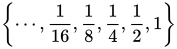
This description requires one to consummate an space number of tasks, which Zeno maintains is an impossibility.[xi]
This sequence also presents a second problem in that it contains no first altitude to run, for any possible (finite) first distance could exist divided in half, and hence would not be first subsequently all. Hence, the trip cannot fifty-fifty begin. The paradoxical decision then would be that travel over whatsoever finite altitude can exist neither completed nor begun, and so all motion must be an illusion.[12]
This statement is called the "Dichotomy" considering it involves repeatedly splitting a distance into two parts. An case with the original sense can be plant in an asymptote. Information technology is also known as the Race Form paradox.
Achilles and the tortoise [edit]

Achilles and the tortoise
In a race, the quickest runner can never overhave the slowest, since the pursuer must first reach the point whence the pursued started, then that the slower must always concur a lead.
In the paradox of Achilles and the tortoise, Achilles is in a footrace with the tortoise. Achilles allows the tortoise a head start of 100 meters, for example. Suppose that each racer starts running at some abiding speed, one faster than the other. After some finite time, Achilles will accept run 100 meters, bringing him to the tortoise'due south starting point. During this time, the tortoise has run a much shorter distance, say 2 meters. It will then accept Achilles some farther time to run that distance, by which fourth dimension the tortoise will have advanced farther; and and so more fourth dimension even so to reach this third bespeak, while the tortoise moves ahead. Thus, whenever Achilles arrives somewhere the tortoise has been, he still has some distance to go before he can even reach the tortoise. As Aristotle noted, this argument is similar to the Dichotomy.[13] It lacks, even so, the apparent conclusion of motionlessness.
Pointer paradox [edit]
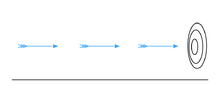
If everything when it occupies an equal space is at rest at that instant of time, and if that which is in locomotion is always occupying such a space at whatever moment, the flying arrow is therefore motionless at that instant of time and at the adjacent instant of fourth dimension but if both instants of time are taken equally the aforementioned instant or continuous instant of time then information technology is in motion.[14]
In the arrow paradox, Zeno states that for motion to occur, an object must change the position which it occupies. He gives an example of an arrow in flight. He states that in any one (duration-less) instant of time, the arrow is neither moving to where it is, nor to where it is not.[15] It cannot motility to where information technology is not, considering no fourth dimension elapses for it to move in that location; it cannot move to where it is, because it is already at that place. In other words, at every instant of fourth dimension there is no motion occurring. If everything is motionless at every instant, and fourth dimension is entirely composed of instants, then motion is impossible.
Whereas the start two paradoxes divide infinite, this paradox starts by dividing fourth dimension—and not into segments, only into points.[16]
3 other paradoxes as given by Aristotle [edit]
Paradox of identify [edit]
From Aristotle:
If everything that exists has a place, identify as well volition have a identify, and and then on ad infinitum.[17]
Paradox of the grain of millet [edit]
Clarification of the paradox from the Routledge Dictionary of Philosophy:
The statement is that a single grain of millet makes no audio upon falling, but a thousand grains make a sound. Hence a thousand nothings become something, an absurd decision.[18]
Aristotle's refutation:
Zeno is wrong in maxim that there is no part of the millet that does not make a sound: for at that place is no reason why whatever such function should not in any length of time fail to move the air that the whole bushel moves in falling. In fact it does non of itself move fifty-fifty such a quantity of the air equally it would movement if this part were by itself: for no function fifty-fifty exists otherwise than potentially.[19]
Description from Nick Huggett:
This is a Parmenidean argument that one cannot trust one's sense of hearing. Aristotle's response seems to exist that even inaudible sounds tin can add together to an audible audio.[20]
The moving rows (or stadium) [edit]

From Aristotle:
... concerning the ii rows of bodies, each row being composed of an equal number of bodies of equal size, passing each other on a race-class as they go on with equal velocity in reverse directions, the one row originally occupying the infinite between the goal and the eye betoken of the course and the other that between the middle indicate and the starting-mail service. This...involves the conclusion that half a given time is equal to double that time.[21]
For an expanded business relationship of Zeno's arguments every bit presented by Aristotle, see Simplicius'southward commentary On Aristotle's Physics.[ full citation needed ]
Proposed solutions [edit]
Diogenes the Cynic [edit]
According to Simplicius, Diogenes the Cynic said nothing upon hearing Zeno'due south arguments, but stood upwards and walked, in guild to demonstrate the falsity of Zeno's conclusions (run across solvitur ambulando). To fully solve any of the paradoxes, even so, 1 needs to show what is wrong with the argument, not only the conclusions. Through history, several solutions have been proposed, amidst the primeval recorded being those of Aristotle and Archimedes.
Aristotle [edit]
Aristotle (384 BC−322 BC) remarked that as the altitude decreases, the time needed to cover those distances as well decreases, and so that the time needed as well becomes increasingly small.[22] [ failed verification ] [23] Aristotle also distinguished "things infinite in respect of divisibility" (such every bit a unit of space that can be mentally divided into ever smaller units while remaining spatially the same) from things (or distances) that are infinite in extension ("with respect to their extremities").[24] Aristotle's objection to the arrow paradox was that "Fourth dimension is not composed of indivisible nows any more than any other magnitude is composed of indivisibles."[25]
Archimedes [edit]
Before 212 BC, Archimedes had developed a method to derive a finite answer for the sum of infinitely many terms that get progressively smaller. (See: Geometric series, 1/4 + i/16 + 1/64 + one/256 + · · ·, The Quadrature of the Parabola.) His argument, applying the method of exhaustion to bear witness that the infinite sum in question is equal to the area of a particular square, is largely geometric but quite rigorous. Today's assay achieves the aforementioned result, using limits (see convergent series). These methods allow the construction of solutions based on the atmospheric condition stipulated by Zeno, i.e. the amount of time taken at each step is geometrically decreasing.[6] [26]
Thomas Aquinas [edit]
Thomas Aquinas, commenting on Aristotle's objection, wrote "Instants are non parts of time, for time is not made upwards of instants any more a magnitude is made of points, as nosotros have already proved. Hence information technology does not follow that a thing is non in movement in a given time, just considering it is not in motion in any instant of that time."[27]
Bertrand Russell [edit]
Bertrand Russell offered what is known as the "at-at theory of motility". It agrees that there can be no move "during" a durationless instant, and contends that all that is required for motion is that the arrow be at 1 point at 1 time, at another point some other fourth dimension, and at appropriate points between those 2 points for intervening times. In this view motion is just change in position over time.[28] [29]
Hermann Weyl [edit]
Another proposed solution is to question ane of the assumptions Zeno used in his paradoxes (particularly the Dichotomy), which is that between any ii different points in space (or fourth dimension), there is ever another point. Without this assumption there are simply a finite number of distances betwixt two points, hence there is no infinite sequence of movements, and the paradox is resolved. Co-ordinate to Hermann Weyl, the assumption that space is made of finite and discrete units is subject to a farther problem, given by the "tile argument" or "distance function trouble".[30] [31] According to this, the length of the hypotenuse of a right angled triangle in discretized space is always equal to the length of one of the two sides, in contradiction to geometry. Jean Paul Van Bendegem has argued that the Tile Argument can be resolved, and that discretization tin can therefore remove the paradox.[6] [32]
Henri Bergson [edit]
An alternative conclusion, proposed by Henri Bergson in his 1896 book Matter and Memory, is that, while the path is divisible, the motion is non.[33] In this statement, instants in time and instantaneous magnitudes do not physically exist. An object in relative movement cannot have an instantaneous or determined relative position, and and so cannot accept its movement fractionally dissected.
Peter Lynds [edit]
In 2003, Peter Lynds put forth a very similar argument: all of Zeno'southward movement paradoxes are resolved past the determination that instants in time and instantaneous magnitudes practice non physically exist.[34] [35] [36] [37] Lynds argues that an object in relative motion cannot have an instantaneous or determined relative position (for if it did, it could not exist in motion), and so cannot take its movement fractionally dissected as if it does, equally is assumed by the paradoxes. For more nearly the inability to know both speed and location, see Heisenberg dubiousness principle.
Nick Huggett [edit]
Nick Huggett argues that Zeno is assuming the conclusion when he says that objects that occupy the aforementioned space as they do at rest must exist at rest.[16]
Paradoxes in modern times [edit]
Infinite processes remained theoretically troublesome in mathematics until the late 19th century. With the epsilon-delta definition of limit, Weierstrass and Cauchy developed a rigorous conception of the logic and calculus involved. These works resolved the mathematics involving infinite processes.[38] [39]
While mathematics tin calculate where and when the moving Achilles will overtake the Tortoise of Zeno's paradox, philosophers such as Kevin Brown[vii] and Francis Moorcroft[8] claim that mathematics does non address the central point in Zeno'due south argument, and that solving the mathematical issues does not solve every consequence the paradoxes raise.
Popular literature often misrepresents Zeno'southward arguments. For example, Zeno is often said to take argued that the sum of an infinite number of terms must itself be infinite–with the consequence that non simply the fourth dimension, simply also the distance to be travelled, get infinite.[40] However, none of the original ancient sources has Zeno discussing the sum of any infinite serial. Simplicius has Zeno saying "it is impossible to traverse an infinite number of things in a finite time". This presents Zeno's trouble non with finding the sum, merely rather with finishing a job with an infinite number of steps: how can one ever get from A to B, if an infinite number of (non-instantaneous) events can be identified that need to precede the arrival at B, and i cannot attain even the beginning of a "last event"?[7] [eight] [9] [41]
A humorous accept is offered by Tom Stoppard in his 1972 play Jumpers, in which the principal protagonist, the philosophy professor George Moore, suggests that according to Zeno's paradox, Saint Sebastian, a third Century Christian saint martyred past being shot with arrows, died of fright.
Argue continues on the question of whether or not Zeno'due south paradoxes have been resolved. In The History of Mathematics: An Introduction (2010) Burton writes, "Although Zeno's argument confounded his contemporaries, a satisfactory explanation incorporates a now-familiar thought, the notion of a 'convergent infinite series.'"[42]
Bertrand Russell offered a "solution" to the paradoxes based on the piece of work of Georg Cantor,[43] only Brown concludes "Given the history of 'final resolutions', from Aristotle onwards, it's probably foolhardy to call up we've reached the end. It may be that Zeno's arguments on motion, because of their simplicity and universality, will ever serve as a kind of 'Rorschach image' onto which people can projection their almost fundamental phenomenological concerns (if they have any)."[vii]
A similar ancient Chinese philosophic consideration [edit]
Aboriginal Chinese philosophers from the Mohist School of Names during the Warring States period of Prc (479-221 BC) developed equivalents to some of Zeno'due south paradoxes.[44] The scientist and historian Sir Joseph Needham, in his Scientific discipline and Civilisation in China, describes an ancient Chinese paradox from the surviving Mohist School of Names book of logic which states, in the archaic aboriginal Chinese script, "a one-pes stick, every mean solar day take abroad one-half of it, in a myriad ages it will not exist exhausted." Several other paradoxes from this philosophical school (more precisely, movement) are known, just their modernistic interpretation is more speculative.
Quantum Zeno effect [edit]
In 1977,[45] physicists E. C. George Sudarshan and B. Misra discovered that the dynamical evolution (motion) of a breakthrough arrangement can be hindered (or even inhibited) through observation of the system.[46] This effect is ordinarily chosen the "quantum Zeno effect" as it is strongly reminiscent of Zeno's arrow paradox. This result was first theorized in 1958.[47]
Zeno behaviour [edit]
In the field of verification and pattern of timed and hybrid systems, the system behaviour is chosen Zeno if information technology includes an infinite number of discrete steps in a finite amount of time.[48] Some formal verification techniques exclude these behaviours from analysis, if they are not equivalent to non-Zeno behaviour.[49] [50] In systems design these behaviours will likewise often be excluded from system models, since they cannot be implemented with a digital controller.[51]
Lewis Carroll and Douglas Hofstadter [edit]
What the Tortoise Said to Achilles, [52] written in 1895 by Lewis Carroll, was an attempt to reveal an coordinating paradox in the realm of pure logic. If Carroll's argument is valid, the implication is that Zeno's paradoxes of movement are not essentially bug of space and time, but go right to the heart of reasoning itself. Douglas Hofstadter made Carroll's article a centrepiece of his book Gödel, Escher, Bach: An Eternal Golden Braid, writing many more dialogues between Achilles and the Tortoise to elucidate his arguments. Hofstadter connects Zeno'south paradoxes to Gödel'southward incompleteness theorem in an attempt to demonstrate that the bug raised by Zeno are pervasive and manifest in formal systems theory, computing and the philosophy of listen.
See likewise [edit]
- Incommensurable magnitudes
- Infinite regress
- Philosophy of infinite and fourth dimension
- Renormalization
- Ross–Littlewood paradox
- School of Names
- Supertask
- "What the Tortoise Said to Achilles", an allegorical dialogue on the foundations of logic by Lewis Carroll (1895).
- Zeno machine
- List of Paradoxes
Notes [edit]
- ^ Parmenides 128d
- ^ Parmenides 128a–b
- ^ a b Aristotle'southward Physics "Physics" by Aristotle translated past R. P. Hardie and R. K. Gaye
- ^ "Greek text of "Physics" by Aristotle (refer to §four at the tiptop of the visible screen expanse)". Archived from the original on 2008-05-sixteen.
- ^ ([fragment 65], Diogenes Laërtius. IX Archived 2010-12-12 at the Wayback Machine 25ff and Viii 57).
- ^ a b c Boyer, Carl (1959). The History of the Calculus and Its Conceptual Evolution . Dover Publications. p. 295. ISBN978-0-486-60509-8 . Retrieved 2010-02-26 .
If the paradoxes are thus stated in the precise mathematical terminology of continuous variables (...) the seeming contradictions resolve themselves.
- ^ a b c d Brown, Kevin. "Zeno and the Paradox of Motility". Reflections on Relativity. Archived from the original on 2012-12-05. Retrieved 2010-06-06 .
- ^ a b c Moorcroft, Francis. "Zeno's Paradox". Archived from the original on 2010-04-eighteen.
- ^ a b Papa-Grimaldi, Alba (1996). "Why Mathematical Solutions of Zeno'southward Paradoxes Miss the Point: Zeno'south One and Many Relation and Parmenides' Prohibition" (PDF). The Review of Metaphysics. 50: 299–314.
- ^ Diogenes Laërtius, Lives, 9.23 and ix.29.
- ^ Lindberg, David (2007). The Beginnings of Western Scientific discipline (2d ed.). Academy of Chicago Press. p. 33. ISBN978-0-226-48205-7.
- ^ Huggett, Nick (2010). "Zeno'due south Paradoxes: 3.1 The Dichotomy". Stanford Encyclopedia of Philosophy . Retrieved 2011-03-07 .
- ^ Huggett, Nick (2010). "Zeno'due south Paradoxes: three.2 Achilles and the Tortoise". Stanford Encyclopedia of Philosophy . Retrieved 2011-03-07 .
- ^ Aristotle. "Physics". The Internet Classics Archive.
Zeno's reasoning, however, is beguiling, when he says that if everything when it occupies an equal space is at residue, and if that which is in locomotion is always occupying such a infinite at whatever moment, the flying pointer is therefore motionless. This is fake, for fourth dimension is not composed of indivisible moments whatever more than any other magnitude is composed of indivisibles.
- ^ Laërtius, Diogenes (c. 230). "Pyrrho". Lives and Opinions of Eminent Philosophers. Vol. 9. passage 72. ISBN1-116-71900-2.
- ^ a b Huggett, Nick (2010). "Zeno's Paradoxes: 3.3 The Arrow". Stanford Encyclopedia of Philosophy . Retrieved 2011-03-07 .
- ^ Aristotle Physics IV:1, 209a25
- ^ The Michael Proudfoot, A.R. Lace. Routledge Dictionary of Philosophy. Routledge 2009, p. 445
- ^ Aristotle Physics Vii:5, 250a20
- ^ Huggett, Nick, "Zeno'southward Paradoxes", The Stanford Encyclopedia of Philosophy (Winter 2010 Edition), Edward North. Zalta (ed.), http://plato.stanford.edu/entries/paradox-zeno/#GraMil
- ^ Aristotle Physics VI:9, 239b33
- ^ Aristotle. Physics 6.9
- ^ Aristotle'southward observation that the fractional times also get shorter does not guarantee, in every case, that the task can be completed. Ane example in which it does not hold is that in which the fractional times decrease in a harmonic series, while the distances subtract geometrically, such as: i/two s for 1/2 m proceeds, 1/iii s for next ane/4 grand gain, 1/iv due south for side by side one/8 yard gain, one/5 s for side by side one/16 m gain, ane/6 s for next 1/32 m gain, etc. In this case, the distances class a convergent series, just the times grade a divergent series, the sum of which has no limit.[ original research? ] Archimedes developed a more than explicitly mathematical approach than Aristotle.
- ^ Aristotle. Physics half dozen.9; 6.2, 233a21-31
- ^ Aristotle. Physics. Vol. Half-dozen. Office 9 verse: 239b5. ISBN0-585-09205-2.
- ^ George B. Thomas, Calculus and Analytic Geometry, Addison Wesley, 1951
- ^ Aquinas. Commentary on Aristotle's Physics, Book 6.861
- ^ Huggett, Nick (1999). Space From Zeno to Einstein. ISBN0-262-08271-3.
- ^ Salmon, Wesley C. (1998). Causality and Caption. p. 198. ISBN978-0-19-510864-4.
- ^ Van Bendegem, Jean Paul (17 March 2010). "Finitism in Geometry". Stanford Encyclopedia of Philosophy . Retrieved 2012-01-03 .
- ^ Cohen, Marc (eleven December 2000). "ATOMISM". History of Aboriginal Philosophy, University of Washington. Archived from the original on July 12, 2010. Retrieved 2012-01-03 .
- ^ van Bendegem, Jean Paul (1987). "Give-and-take:Zeno'due south Paradoxes and the Tile Argument". Philosophy of Science. Belgium. 54 (ii): 295–302. doi:10.1086/289379. JSTOR 187807.
- ^ Bergson, Henri (1896). Matière et Mémoire [Matter and Retention] (PDF). Translation 1911 by Nancy Margaret Paul & Due west. Scott Palmer. George Allen and Unwin. pp. 77–78 of the PDF.
- ^ "Zeno'due south Paradoxes: A Timely Solution". January 2003.
- ^ Lynds, Peter. Time and Classical and Quantum Mechanics: Indeterminacy vs. Discontinuity. Foundations of Physics Letter of the alphabet s (Vol. 16, Result 4, 2003). doi:10.1023/A:1025361725408
- ^ Time'due south Up, Einstein, Josh McHugh, Wired Magazine, June 2005
- ^ South E Robbins (2004) On time, retention and dynamic form. Consciousness and Cognition 13(4), 762-788: "Lynds, his reviewers and consultants (e.1000., J.J.C. Smart) are plainly unaware of his total precedence by Bergson"
- ^ Lee, Harold (1965). "Are Zeno's Paradoxes Based on a Mistake?". Mind. Oxford University Press. 74 (296): 563–570. doi:10.1093/mind/LXXIV.296.563. JSTOR 2251675.
- ^ B Russell (1956) Mathematics and the metaphysicians in "The World of Mathematics" (ed. J R Newman), pp 1576-1590.
- ^ Benson, Donald C. (1999). The Moment of Proof : Mathematical Epiphanies . New York: Oxford University Press. p. 14. ISBN978-0195117219.
- ^ Huggett, Nick (2010). "Zeno's Paradoxes: five. Zeno'south Influence on Philosophy". Stanford Encyclopedia of Philosophy . Retrieved 2011-03-07 .
- ^ Burton, David, A History of Mathematics: An Introduction, McGraw Hill, 2010, ISBN 978-0-07-338315-half dozen
- ^ Russell, Bertrand (2002) [Start published in 1914 by The Open Court Publishing Visitor]. "Lecture 6. The Problem of Infinity Considered Historically". Our Noesis of the External World: As a Field for Scientific Method in Philosophy. Routledge. p. 169. ISBN0-415-09605-vii.
- ^ "School of Names > Miscellaneous Paradoxes (Stanford Encyclopedia of Philosophy)". plato.stanford.edu . Retrieved 2020-01-xxx .
- ^ Sudarshan, E. C. G.; Misra, B. (1977). "The Zeno's paradox in quantum theory" (PDF). Journal of Mathematical Physics. 18 (4): 756–763. Bibcode:1977JMP....18..756M. doi:ten.1063/1.523304. OSTI 7342282.
- ^ W.M.Itano; D.J. Heinsen; J.J. Bokkinger; D.J. Wineland (1990). "Quantum Zeno effect" (PDF). Physical Review A. 41 (5): 2295–2300. Bibcode:1990PhRvA..41.2295I. doi:ten.1103/PhysRevA.41.2295. PMID 9903355. Archived from the original (PDF) on 2004-07-twenty. Retrieved 2004-07-23 .
- ^ Khalfin, L.A. (1958). "Contribution to the Disuse Theory of a Quasi-Stationary State". Soviet Phys. JETP. six: 1053. Bibcode:1958JETP....vi.1053K.
- ^ Paul A. Fishwick, ed. (1 June 2007). "15.6 "Pathological Behavior Classes" in chapter 15 "Hybrid Dynamic Systems: Modeling and Execution" by Pieter J. Mosterman, The Mathworks, Inc.". Handbook of dynamic organisation modeling. Chapman & Hall/CRC Figurer and Information Scientific discipline (hardcover ed.). Boca Raton, Florida, United states of america: CRC Press. pp. 15–22 to 15–23. ISBN978-i-58488-565-8 . Retrieved 2010-03-05 .
- ^ Lamport, Leslie (2002). Specifying Systems (PDF). Microsoft Research. Addison-Wesley. p. 128. ISBN0-321-14306-Ten . Retrieved 2010-03-06 .
- ^ Zhang, Jun; Johansson, Karl; Lygeros, John; Sastry, Shankar (2001). "Zeno hybrid systems" (PDF). International Periodical for Robust and Nonlinear Control. 11 (5): 435. doi:x.1002/rnc.592. Archived from the original (PDF) on August 11, 2011. Retrieved 2010-02-28 .
- ^ Franck, Cassez; Henzinger, Thomas; Raskin, Jean-Francois (2002). "A Comparison of Control Problems for Timed and Hybrid Systems". Archived from the original on May 28, 2008. Retrieved 2010-03-02 .
- ^ Carroll, Lewis (1895-04-01). "What the Tortoise Said to Achilles". Mind. Iv (14): 278–280. doi:10.1093/mind/4.14.278. ISSN 0026-4423.
References [edit]
- Kirk, Thou. S., J. East. Raven, M. Schofield (1984) The Presocratic Philosophers: A Disquisitional History with a Selection of Texts, second ed. Cambridge University Press. ISBN 0-521-27455-9.
- Huggett, Nick (2010). "Zeno's Paradoxes". Stanford Encyclopedia of Philosophy . Retrieved 2011-03-07 .
- Plato (1926) Plato: Cratylus. Parmenides. Greater Hippias. Lesser Hippias, H. N. Fowler (Translator), Loeb Classical Library. ISBN 0-674-99185-0.
- Sainsbury, R.Thou. (2003) Paradoxes, 2nd ed. Cambridge Academy Press. ISBN 0-521-48347-vi.
External links [edit]
- Dowden, Bradley. "Zeno'due south Paradoxes." Entry in the Cyberspace Encyclopedia of Philosophy.
- "Antinomy", Encyclopedia of Mathematics, European monetary system Printing, 2001 [1994]
- Introduction to Mathematical Philosophy, Ludwig-Maximilians-Universität München
- Silagadze, Z. M. "Zeno meets modern science,"
- Zeno'southward Paradox: Achilles and the Tortoise by Jon McLoone, Wolfram Demonstrations Project.
- Kevin Brown on Zeno and the Paradox of Motion
- Palmer, John (2008). "Zeno of Elea". Stanford Encyclopedia of Philosophy.
- This article incorporates material from Zeno'southward paradox on PlanetMath, which is licensed under the Creative Eatables Attribution/Share-Alike License.
- Grime, James. "Zeno's Paradox". Numberphile. Brady Haran. Archived from the original on 2018-10-03. Retrieved 2013-04-thirteen .
Source: https://en.wikipedia.org/wiki/Zeno%27s_paradoxes
0 Response to "Youll Never Pass This Way Again"
Postar um comentário